 Cherish
Cherish
Cherish
Choosing the right Painting Line is a production decision, not merely an equipment purchase. It affects coating quality, labor demand, energy use, maintenance, and delivery reliability. Grand View Research reported that the global paints and coatings market was valued at approximately USD 206.56 billion in 2023. The same report expects continued growth through 2030. This expansion increases pressure on factories to improve throughput without sacrificing finish consistency.
A practical assessment should begin with the product itself. Steel cabinets, automotive parts, aluminum profiles, and plastic components require different pretreatment, application, curing, and conveying methods. A thin sheet may need controlled powder coverage. A heavy frame may require longer oven residence time. These details determine whether a conveyor system, spray booth, dip tank, or hybrid process is appropriate. According to the International Energy Agency, industry remains one of the largest global energy consumers. Therefore, oven insulation, burner efficiency, heat recovery, and line balancing deserve early attention. Small energy losses become expensive when the oven runs continuously.
The right Painting Line must also match future production, not only today’s order volume. Industry 4.0 reports from Deloitte consistently identify data visibility and predictive maintenance as important manufacturing priorities. Sensors can track temperature, humidity, conveyor speed, and filter pressure. Useful information, not decoration. However, automation is not automatically the best answer. A highly automated line can become difficult to adjust when product mixes change. This is where factory experience matters. Operators should test sample parts, record coating thickness, inspect corner coverage, and calculate total operating cost. Some decisions will still involve uncertainty. That is acceptable, provided assumptions are measured, documented, and reviewed before installation.
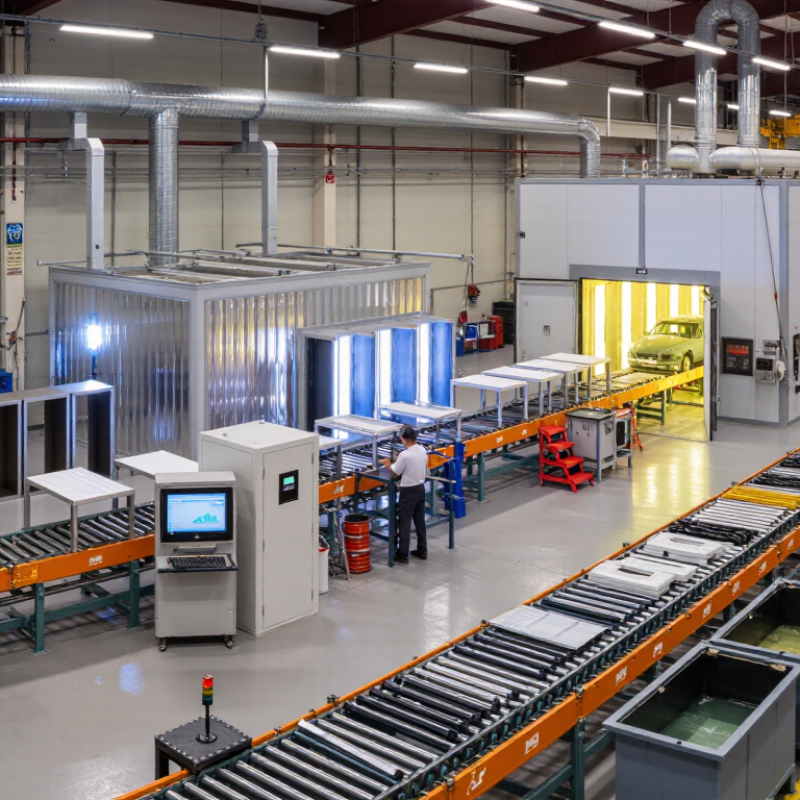
Factory Painting Line Basics and Core Selection Criteria
A painting line begins with the workpiece, not the spray booth. Record substrate, dimensions, weight, surface condition, and target output. A 600-millimeter panel needs different handling than a two-meter frame. Define takt time, batch size, coating thickness, and color changes before requesting equipment proposals. The European Commission’s 2020 Best Available Techniques Reference Document for Surface Treatment emphasizes controlled pretreatment, efficient application, and managed exhaust systems. These stages directly affect adhesion and emissions.
Pretreatment may include cleaning, rinsing, drying, and conversion coating. Select each stage according to corrosion requirements and substrate chemistry. Then compare liquid, powder, or dual-technology application. Powder systems can reduce solvent use, but recovery, grounding, and curing space remain essential. The U.S. Energy Information Administration reports that industrial facilities consume roughly one-third of global delivered energy. Oven insulation, airflow balance, and heat recovery deserve serious attention. Small losses become expensive.
Control architecture also matters. Deloitte’s 2024 Smart Manufacturing and Operations Survey found that 86% of manufacturers view smart manufacturing as important to competitiveness. Use sensors for temperature, conveyor speed, pressure, and filter loading. Keep records by batch. A line can look efficient on paper and still disappoint. I would test the hardest product first, not the easiest sample. That choice may slow the project. It can expose weak airflow, uneven curing, or excessive changeover waste before installation. Allow room for maintenance access and future capacity. A crowded line often becomes an expensive compromise.
| Painting Line Type | Typical Process | Suitable Materials | Typical Operating Temperature | Typical Throughput | Typical Line Footprint | Main Advantages | Main Limitations | Best-Fit Applications |
|---|---|---|---|---|---|---|---|---|
| Powder Coating Line | Pre-treatment → drying → electrostatic powder application → curing oven → cooling | Steel, galvanized steel, aluminum and other heat-resistant metals | Curing commonly requires approximately 160–200°C metal temperature | Approximately 100–1,500 parts/hour, depending on part size and hanger density | Approximately 30–120 m for a conveyorized line | High transfer efficiency, low solvent emissions, durable finish and recyclable overspray | Requires oven curing; unsuitable for heat-sensitive substrates; color changes require cleaning | Metal furniture, appliances, electrical cabinets, automotive components and general industrial parts |
| Liquid Spray Painting Line | Cleaning or pre-treatment → primer → flash-off → topcoat → drying or baking | Metal, plastic, wood, composite materials and heat-sensitive components | Air drying may be 20–30°C; force drying commonly ranges from 40–120°C | Approximately 20–300 parts/hour, depending on coating system and manual or automatic operation | Approximately 20–100 m for a conveyorized line | Wide color range, smooth appearance and compatibility with many substrates | Uses liquid paint and may require solvent control, ventilation and wastewater treatment | Machinery, vehicles, plastic parts, wood products and products requiring premium appearance |
| Electrocoat Line | Cleaning → phosphate or conversion coating → immersion electrocoating → rinsing → oven curing | Conductive steel, galvanized steel and aluminum components | Curing commonly requires approximately 150–190°C, depending on coating chemistry | Approximately 30–250 parts/hour, depending on tank size and part geometry | Approximately 50–150 m, including tanks, rinses and curing oven | Excellent coverage inside cavities, consistent film thickness and strong corrosion resistance | High initial investment, chemical management requirements and limited use on nonconductive materials | Automotive components, structural parts, chassis components and corrosion-sensitive metal assemblies |
| Dip or Immersion Coating Line | Cleaning → immersion coating → draining → drying or curing | Metal parts and selected plastic or composite parts, depending on coating chemistry | Typically 20–180°C, depending on whether the coating is air-dried or thermally cured | Approximately 20–200 parts/hour | Approximately 15–80 m for a small or medium conveyorized system | Good coverage of complex shapes, relatively simple equipment and low spray overspray | Draining marks, bath contamination and limited control of coating thickness on some geometries | Fasteners, small metal components, wire products and parts with complex profiles |
| Robotic Spray Line | Automated loading → robotic primer and topcoat application → flash-off → drying or curing | Metal, plastic, composite and other components compatible with the selected paint system | Approximately 20–30°C spray-room temperature; drying or curing commonly 40–180°C | Approximately 40–400 parts/hour, depending on robot count, cycle time and part dimensions | Approximately 40–150 m, including safety areas and paint booths | Repeatable film thickness, reduced operator exposure and consistent coating quality | Higher programming and maintenance requirements; less economical for highly variable low-volume work | Medium- to high-volume products with stable geometry and repeatable coating specifications |
| Coil Coating Line | Uncoiling → cleaning and chemical treatment → roll coating → oven curing → cooling → recoiling | Steel and aluminum coils supplied in continuous strip form | Oven zones commonly operate at approximately 180–300°C air temperature | Approximately 20–150 m/min, depending on coating system, strip width and curing requirements | Approximately 100–300 m or more for a full continuous line | Very high productivity, uniform coating and low unit cost at large production volumes | Only suitable for continuous strip; very high capital cost and limited product flexibility | Roofing panels, building panels, appliances and continuously formed metal products |
| Selection Dimension | Key Data to Confirm | Practical Selection Guidance | Recommended Target or Checkpoint |
|---|---|---|---|
| Product Material | Substrate type, electrical conductivity, heat resistance and surface condition | Use powder or electrocoat mainly for conductive heat-resistant metals; consider liquid coating for plastics, wood and heat-sensitive parts | Confirm material compatibility before selecting the coating chemistry or oven design |
| Part Size and Geometry | Maximum length, width, height, weight, cavity depth and hanger points | Complex cavities may favor immersion or electrocoat; large flat parts may favor powder, liquid spray or coil coating | Define the largest and heaviest part, not only the average part |
| Required Production Capacity | Parts per hour, working shifts, operating days and required equipment availability | Size the line for actual takt time plus planned downtime, maintenance and product changeovers | Include a practical capacity margin of approximately 10–20% where demand is expected to grow |
| Coating Performance | Corrosion resistance, film thickness, adhesion, appearance, chemical resistance and weathering | Select the process based on the required service environment rather than appearance alone | Set measurable limits for dry-film thickness, adhesion and corrosion-test performance |
| Available Factory Space | Building length, width, clear height, column spacing, floor loading and utility locations | A conveyorized line requires space for loading, pretreatment, drying, painting, flash-off, curing and unloading | Reserve access space for maintenance and safe movement of operators and materials |
| Energy and Utilities | Electricity, natural gas, compressed air, water, drainage and exhaust requirements | Ovens, ventilation systems and pretreatment tanks are usually the major utility consumers | Verify peak load, operating load and utility availability before equipment selection |
| Environmental and Safety Control | Volatile organic compounds, combustible dust, wastewater, ventilation and worker exposure | Liquid lines need solvent and emission controls; powder lines require dust collection and ignition-risk management | Design according to local fire, environmental, occupational safety and wastewater regulations |
| Color and Product Changeover | Number of colors, coating families, batch size and acceptable cleaning time | Frequent color changes favor flexible spray equipment or a dedicated quick-clean powder booth | Measure total changeover time, including booth cleaning, hose cleaning and quality verification |
| Total Cost of Ownership | Equipment cost, installation, labor, energy, coating consumption, maintenance and wastewater treatment | Compare cost per coated part instead of comparing equipment purchase price alone | Prepare a five- to ten-year operating-cost model before final approval |
| Automation Level | Labor availability, product repeatability, quality variation and planned production volume | Manual systems offer flexibility; automatic or robotic systems improve repeatability at stable volumes | Choose automation based on payback, product mix and operator safety requirements |
Note: The operating ranges shown are typical planning values for industrial painting lines. Actual throughput, footprint, temperature and utility consumption depend on part dimensions, coating chemistry, line speed, production mix and local regulations.
Record the substrate, dimensions, weight, surface condition, and target output. Define takt time, batch size, coating thickness, and color changes. A 600-millimeter panel needs different handling from a two-meter frame. Do not start with the spray booth.
Water-based coatings may need longer drying zones and tighter humidity control. Solvent-based coatings require suitable ventilation and safety systems. Powder coatings need controlled recovery, grounding, curing space, and thickness control. Each material behaves differently.
Corners, recesses, and weld seams can collect excess coating. Deep cabinets may cure differently from flat panels. Narrow tubes may require special handling and spray access. Test difficult shapes, not only easy samples.
Pretreatment can include cleaning, rinsing, drying, and conversion coating. Select each stage according to corrosion needs and substrate chemistry. Poor pretreatment can weaken adhesion and increase rejects. The surface tells the truth.
Test viscosity at actual shop-floor temperature. Measure drying time, adhesion, gloss, and curing during pilot runs. Keep samples from different shifts for comparison. Laboratory data helps, but factory conditions can disagree.
Compare oven temperature, heating time, airflow, and production schedules. Improve insulation and avoid leaving oven doors open. Heat recovery and variable-speed fans may reduce energy use. Small losses become expensive.
Include loading zones, ovens, inspection areas, maintenance access, and waste storage. Keep walkways clear around tanks and control panels. Leave room for future capacity. A crowded line becomes a costly compromise.
Provide ventilation, spill control, emergency access, and clearly labeled containers. Separate pedestrians from forklifts with barriers and marked routes. Check filtration, exhaust treatment, wastewater handling, and waste records. Practical shutdown drills matter.
Monitor temperature, conveyor speed, pressure, and filter loading. Keep records by batch and shift. Review coating consumption, defects, maintenance, and changeover time. Our earlier focus on speed was incomplete. Test the hardest product.
Choosing the right Painting Line is an important decision for improving product quality, production efficiency, and long-term operating stability. Factories should first evaluate the types of coating materials, product sizes and shapes, required surface finishes, production volume, and drying or curing conditions. These factors help determine whether spray painting, powder coating, dipping, or other technologies are most suitable. The required level of automation should also be considered, from manual workstations to fully integrated systems with automatic conveying, coating, curing, and inspection processes.
A successful selection must also account for available space, energy consumption, worker safety, ventilation, waste management, and environmental compliance. Cost evaluation should include equipment investment, installation, daily operation, maintenance, spare parts, and potential production downtime. Finally, factories should consider future expansion, product changes, and automation upgrades. By balancing technical requirements, operating costs, safety responsibilities, and long-term flexibility, manufacturers can choose a Painting Line that supports consistent quality and sustainable business growth.
