
Cherish
Choosing among the top 10 Spraying Line manufacturers is not a simple comparison of machines. Global buyers must examine production demands, coating quality, energy use, service coverage, and long-term reliability. A line that performs well in Germany may struggle in a humid factory elsewhere. Local ventilation, operator training, paint viscosity, and spare-part access can change the result.
Dr. Markus Keller, an industrial coating systems consultant, says, “A spraying line is only as reliable as its preparation, control, and maintenance.” This practical view guides the evaluation in this article. We look beyond polished brochures and impressive factory photographs. The review considers automatic and manual systems, powder and liquid coating compatibility, conveyor stability, booth design, curing performance, and control-system flexibility. Small details matter. A blocked filter can reduce finish quality. Weak after-sales support can stop production for days.
The selected manufacturers are assessed through technical capability, documented experience, customization options, safety practices, and international service. Their results may differ by industry. Automotive parts need repeatable film thickness. Metal furniture may prioritize speed and color change efficiency. Agricultural equipment often requires larger booths and tougher coatings. No manufacturer is perfect. Public information is sometimes incomplete, and buyer feedback can be difficult to compare fairly. Therefore, this ranking should support deeper technical checks, not replace them. Before purchasing, global buyers should request sample testing, reference projects, maintenance plans, and clear performance terms. A lower initial price may become expensive when downtime begins. Conversely, the most advanced system may exceed a smaller factory’s real needs.
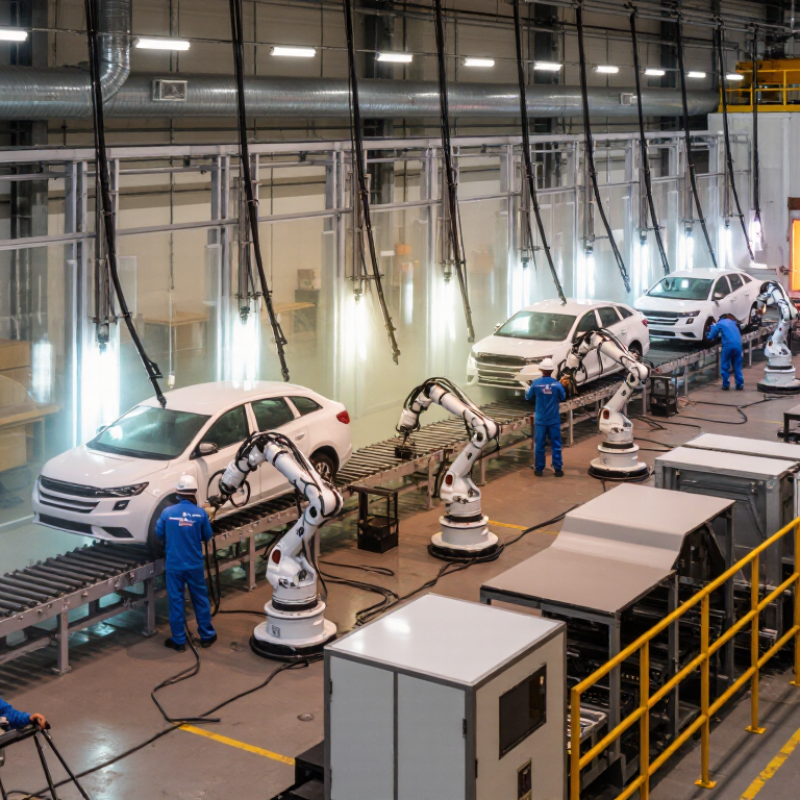
A spraying line is an integrated production system for coating metal, plastic, or composite parts. It usually includes cleaning, surface preparation, drying, spraying, curing, and inspection. Parts move on hooks or conveyors through controlled zones. In powder coating, electrostatic guns charge particles before they reach grounded workpieces. An oven then melts and bonds the powder. Wet-paint lines use atomized liquid and may require flash-off before curing. The exact layout depends on part size, coating chemistry, and required output.
Grand View Research reported that the global powder coatings market exceeded USD 12 billion in 2023. This growth increases demand for stable transfer efficiency, repeatable film thickness, and lower material waste. A serious manufacturer should provide airflow calculations, oven temperature mapping, conveyor-load testing, and maintenance records. ISO 9001-based quality systems also help buyers verify process control. Still, a polished factory tour proves little. Poor grounding, uneven pretreatment, or rushed curing can quietly reduce adhesion. I have seen impressive lines underperform because operators ignored small settings.
Tips: Ask for coated sample panels, energy-use data, and measured recovery rates. Check whether technicians can adjust spray distance, voltage, airflow, and conveyor speed. Also request safety documentation and realistic production trials. The cheapest quotation may become expensive after rework, downtime, and spare-parts delays.
Spraying lines now combine robotic applicators, electrostatic charging, and closed-loop flow controls. These systems help coat complex parts evenly, from appliance panels to vehicle frames. The International Federation of Robotics’ World Robotics 2024 report recorded 541,302 industrial robot installations worldwide in 2023. That figure reflects broad factory automation, not spraying alone. Still, it shows why buyers increasingly assess robot integration alongside booth design and conveyor speed. An awkward corner can remain undercoated, even when the robot path looks precise.
The International Energy Agency’s Energy Efficiency 2023 report states that industry accounted for about 37% of global energy use in 2022. For a spraying line, curing ovens and booth ventilation deserve close attention. Efficient airflow, heat recovery, and low-temperature curing can reduce operating demand, depending on the coating and substrate. The trade-off is real: faster curing may affect finish quality, and automated systems need careful setup. A changed part shape can also increase overspray.
Tips: Ask suppliers for measured transfer efficiency, energy use per coated part, and test panels using your actual geometry. Check cleaning time between colors, too. A line that runs beautifully in a demonstration may behave differently during a busy shift.
Capability-based overview of common spraying-line supplier specializations. The profiles are generic, are not company names, and do not represent a verified ranking by market share.
| No. | Manufacturer Profile | Typical Line Technologies | Common Coating Processes | Typical Applications | Buyer Considerations |
|---|---|---|---|---|---|
| 1 | Automotive body-in-white line integrator | Pretreatment and drying stages, automated spray booths, conveyor systems, and controlled curing ovens; robotic application is common on high-volume lines. | Electrodeposition primer, liquid primer, basecoat, and clearcoat processes, depending on the plant and coating specification. | Passenger-car and light-commercial-vehicle bodies and metal components. | Assess line takt time, coating-quality requirements, oven energy use, process controls, and integration with existing plant equipment. |
| 2 | Industrial powder-coating line builder | Part preparation, drying, powder spray booths, electrostatic application equipment, powder recovery, and curing ovens. | Electrostatic powder coating, with application and cure parameters selected for the powder and substrate. | Metal furniture, electrical enclosures, appliances, fabricated metal parts, and architectural components. | Check part-size limits, color-change needs, powder recovery design, grounding, ventilation, and oven temperature uniformity. |
| 3 | Liquid-paint finishing-line specialist | Spray booths with liquid collection or filtration systems, paint preparation and delivery equipment, conveyors, and flash-off or curing zones. | Air-assisted, airless, and electrostatic liquid spraying; coating systems may include waterborne or solvent-borne materials. | Machinery, vehicle components, general metal products, and products requiring liquid-coating finishes. | Review coating compatibility, booth airflow, overspray capture, solvent handling where applicable, and cleaning requirements. |
| 4 | Robotic spray-cell integrator | Industrial robots, spray guns or rotary atomizers, part-positioning equipment, programmable recipes, and safety-enclosed spray zones. | Automated liquid spraying and, where configured, robotic powder application. | Complex-shaped parts, repeat production runs, and applications where consistent gun paths and repeatability are important. | Confirm robot reach, payload, programming support, part-fixture design, changeover time, and compatibility with the coating process. |
| 5 | Wood and furniture finishing-line supplier | Conveyorized spray machines or enclosed booths, workpiece handling, drying systems, and optional sanding or coating stages. | Liquid stains, sealers, lacquers, and other specified wood finishes; application equipment depends on product geometry and coating. | Cabinet doors, furniture panels, wooden trim, and other manufactured wood products. | Consider substrate handling, finish appearance, dust control, coating-use efficiency, drying capacity, and the range of part sizes. |
| 6 | Glass and ceramics coating-line specialist | Controlled spray application, precision conveyance, drying or curing equipment, and process controls matched to the substrate. | Liquid functional or decorative coatings, selected according to the glass or ceramic product and its required finish. | Glass panels, containers, ceramic products, and other compatible non-metallic substrates. | Validate coating adhesion, substrate handling, application uniformity, cure conditions, and product-specific testing requirements. |
| 7 | Heavy-equipment and large-part line builder | Large spray booths, heavy-duty overhead or floor conveyors, part-positioning systems, and appropriately sized drying or curing zones. | Industrial liquid coating and, for suitable parts and processes, powder coating. | Construction and agricultural machinery, industrial frames, fabricated structures, and large metal assemblies. | Check maximum part dimensions and mass, access for operators or robots, booth airflow, handling capacity, and coating-system requirements. |
| 8 | Compact batch and job-shop system supplier | Batch spray booths, manual or semi-automatic application equipment, part racks, and batch ovens where required. | Liquid spraying or powder coating, configured for the shop's materials, part mix, and production volume. | Small manufacturers, repair operations, custom fabricators, and facilities processing varied part sizes or short runs. | Compare usable booth and oven dimensions, batch capacity, setup effort, ventilation, and the flexibility to handle different products. |
| 9 | Pretreatment and integrated-process line supplier | Cleaning and rinsing stages, surface-conditioning equipment, drying, coating application, and process monitoring as required by the specification. | Spray-applied liquid or powder coatings integrated with the selected substrate-preparation process. | Metal products where surface preparation is an important part of the specified coating process. | Verify substrate and coating compatibility, process-stage requirements, wastewater handling where applicable, and quality-control procedures. |
| 10 | Turnkey plant engineering and line-integration provider | Coordinated booth, conveyor, application, curing, controls, and material-handling systems; scope may include plant layout and commissioning. | Liquid, powder, or mixed-process lines selected to meet the product and production brief. | New finishing plants, line expansions, and facilities replacing or integrating multiple production stages. | Define project boundaries, throughput targets, utilities, safety requirements, commissioning responsibilities, and lifecycle support before procurement. |
Selecting the top 10 spraying line manufacturers requires more than comparing website claims. We examined practical evidence, including factory experience, engineering capability, and documented project performance. Each manufacturer was assessed through production records, quality controls, and technical support. We also considered whether its systems could handle different workpieces, coating materials, conveyor speeds, and curing requirements. A reliable supplier should explain airflow, spray coverage, oven temperature control, and maintenance access clearly. Vague promises were treated cautiously.
Buyer feedback also influenced the selection. We looked for verified installations, stable spare-part supply, installation training, and responsive service after delivery. Export experience mattered, especially for voltage differences, shipping protection, manuals, and local commissioning needs. Safety design and compliance documentation were essential.
However, no ranking is perfect. Published capacity may differ from daily output. Customer reviews can also be incomplete. We therefore compared several evidence sources instead of trusting one impressive case study.
Tips: Request coated test panels before signing. Ask for line speed, energy use, reject rates, and cleaning time in writing. Inspect a running reference line when possible. Check whether the control system records temperature and spray pressure. A cheaper system may create higher labor costs later. Allow space for filters, pumps, and routine access. Small details matter. Some evaluations may still miss hidden service delays, so keep contingency time and budget.
A worldwide top-ten list of spraying line manufacturers is not universal. Buyers usually compare suppliers by process expertise, engineering depth, and service reach. The strongest candidates often include specialists in automated wet-paint lines, powder-coating systems, pretreatment and drying equipment, robotic application, and turnkey factory integration. They may operate across Europe, East Asia, and North America, but location alone proves little. A capable supplier can explain how its line handles part dimensions, coating materials, target output, and available floor space.
Look beyond the brochure. Ask for a process layout, utility requirements, and references from installations with similar products. Check whether spray booths, conveyors, ovens, filtration, and controls are designed to work together. Request measurable details, such as conveyor speed ranges and curing-temperature uniformity. A neat line drawing is useful, but it cannot replace a site visit or a careful acceptance plan. Some rankings overlook this. A famous supplier may still be a poor fit for a small, varied production run.
Tips: Share sample-part dimensions and expected production volume before requesting a quotation. Confirm operator training, spare-part availability, and response times in writing. Compare total operating needs, not only purchase price. Small details matter. Even a well-designed line may need adjustment after real parts enter production.
This chart presents a practical, company-neutral evaluation framework for comparing spraying line manufacturers worldwide. The weighting emphasizes coating uniformity, automation, transfer efficiency, throughput, energy performance, and environmental compliance because these measurable factors strongly influence finished-product quality, operating cost, and long-term production reliability.
A spraying line should be judged against the actual parts and coating process, not a brochure’s headline capacity. Share sample dimensions, material types, target output, and available floor space with each manufacturer. Ask how the line handles part changes, color changes, and uneven surfaces. Small details matter: a deep recess may need a different spray angle, while a crowded conveyor can limit access for maintenance. Request process-trial results using comparable parts, and check whether stated throughput includes loading, curing, and unloading. It often does not. Speak with buyers who run similar equipment, if possible, and ask what required adjustment after installation.
Compare the full project scope, too. Review layout drawings, utility requirements, controls, installation support, operator training, and spare-parts availability. Ask for clear acceptance-test criteria, such as coating thickness consistency and transfer efficiency, rather than vague promises of “high quality.” This part is easy to overlook. A low purchase price may leave commissioning work or routine cleaning costs unclear. Request a written breakdown of exclusions, warranty coverage, and expected maintenance intervals. Then consider how quickly technical staff can respond when a pump, filter, or conveyor sensor stops production. One uncomfortable question helps: what happens if the line misses its target during the first production run? A careful answer is more useful than a polished sales pitch.
A spraying line is an integrated system for coating metal, plastic, or composite parts. It may include cleaning, drying, spraying, curing, and inspection. Parts travel on hooks or conveyors. The layout depends on part size, coating type, and production volume.
Electrostatic guns charge powder particles before spraying them onto grounded workpieces. The coated parts then enter an oven. Heat melts and bonds the powder to the surface. Poor grounding can quietly reduce coverage and adhesion.
Wet-paint systems atomize liquid coating onto the part. The coating may need a flash-off period before curing. Airflow, spray distance, and conveyor speed affect the final finish. Small setting changes matter.
Spraying lines can handle appliance panels, vehicle frames, metal cabinets, and shaped plastic components. Robotic systems help cover complex surfaces. However, awkward corners may remain undercoated. Precision is not perfection.
Request sample panels using parts with similar dimensions and surface conditions. Ask for airflow calculations, oven temperature maps, and conveyor-load tests. Check maintenance records and process-control procedures. A factory tour alone proves little.
Robotic applicators can provide repeatable movement, spray distance, and coating coverage. Closed-loop controls may improve flow stability and film thickness. Operators still need to adjust voltage, airflow, and conveyor speed. Robots need supervision.
Efficient airflow, heat recovery, and lower-temperature curing may reduce operating demand. The suitable choice depends on the coating and substrate. Faster curing can sometimes affect finish quality. Energy savings need measured testing.
Not usually. A low purchase price may hide rework, downtime, spare-parts delays, and high energy use. Compare transfer efficiency, cleaning time, and operating costs. The final decision may still be uncertain.
This article explains what a Spraying Line is and how its coordinated stages prepare, coat, and finish products for consistent results. It explores the technologies that influence modern spraying operations, including automated equipment, application controls, and systems designed to support efficient material use. It also considers the range of industries and production needs that shape the market, while outlining how manufacturers can be assessed for global projects.
The guide presents a framework for understanding the top 10 Spraying Line manufacturers worldwide, focusing on practical selection factors rather than brand names. Buyers can compare potential suppliers by reviewing equipment capabilities, customization options, production capacity, quality management, technical support, and compatibility with project requirements. By considering these factors together, businesses can make a more informed choice and identify a solution suited to their products, facility, and long-term operational goals.
